
Make the bug a feature: At Episcopal Academy, the conditions came first
Written by: Anju Shivaram, AI Project Manager, Middle States Association | Published April 1st 2026
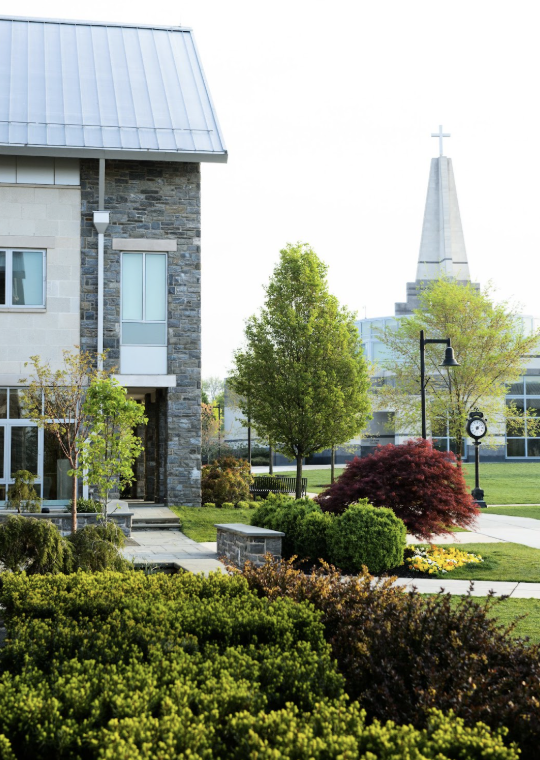
Campus photo provided by Michele Godin
"AI has been kind of a gut punch to education. What do you do with this? If schools aren’t learning organizations, then what are we doing?”
— T.J. Locke, Head of School
A School That Came Prepared
Episcopal Academy (EA) is a PreK-12 independent school outside Philadelphia, founded in 1785. In 2017, a few years before generative AI arrived, EA made a structural bet and built the Center for Teaching and Learning (CTL). It was built to give teachers personalized support (coaching, professional development, and research on the latest tools and methods) to spark collaboration and inspire innovation in the classroom. When Justin Cerenzia joined as its director three years ago, he brought a phrase that fit the school immediately: make the bug a feature. So often, he argued, a disruptive technology like generative AI feels like a problem. Flip it. Turn it into an opportunity. When EA enrolled in the RAIL endorsement in AI Literacy, Safety, and Ethics, Justin was already a member of its Advisory Board. EA came not just for validation but to pressure test the work they were already doing.
What the Sidelines Cost You
T.J. had watched what happened with social media. Schools waited, watched, and reacted too late. With AI, he made a different call. No firm policies. No directives. He asked questions, gave teachers room to experiment, and checked in along the way. What he heard back from department chairs exceeded what he had expected. That gave him patience. The sandbox came before the tools.
From Justin's seat, the stakes were just as clear. Without a foundation, faculty would fall behind. Not all at once. Gradually, discipline by discipline, until the gap became too wide to close.
Influence Over Authority
The CTL gave EA its mechanism for change. Justin describes it as operating without formal authority, only influence. That meant building relationships with department chairs and division heads, moving alongside faculty rather than ahead of them. Early on, he read their hesitance as resistance. RAIL's Pace Layer Model reframed it. The model maps how change moves through a school: daily practices shift quickly, culture and values shift slowly, and knowing which layer you are working in changes everything. Faculty hesitance was not obstruction. It was an institution moving at its natural pace, protecting what it had built well.
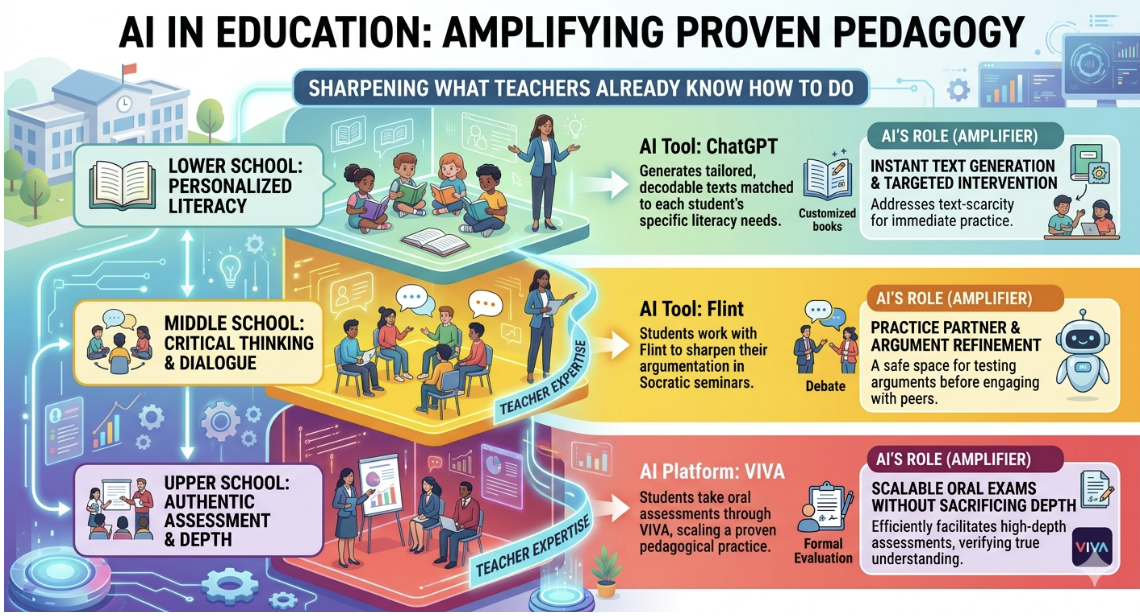
Image: Justin Cerenzia
Philosopher Builders
Flint, an AI learning platform, arrived via a forwarded email Justin nearly dismissed in his second month. He took the call. Flint works as a walled garden: students interact with AI within parameters their teacher sets, while the teacher sees student thinking in real time and receives immediate feedback on individual students and the whole class. Most AI tools serve either the teacher or the student. Flint serves both, and neither loses accountability.
What Flint made possible in one classroom began spreading to others. A lower school teacher used ChatGPT to generate personalized, decodable texts matched to each student's literacy needs. A middle school teacher used Flint to sharpen student argumentation in Socratic seminars. An upper school teacher piloted oral assessments through VIVA, an AI platform that scales a proven pedagogical practice without sacrificing depth. Each tool sharpened something teachers already knew how to do.
A middle school English teacher recently presented her Flint work to the board of trustees. She condensed a 30-minute presentation into six. Teachers are not just adopting tools. They are building with them. When Justin introduced NotebookLM, Google's AI research and note-taking tool, he offered it as a personal organizational aid, a way to sort through a junk drawer. Teachers immediately turned it toward the classroom: "I could do this with my student feedback, my assignments, my curriculum map. He trusts his faculty to make that leap. They do.
Justin borrows a phrase from Harvey Mudd professor Josh Break to describe what he sees in EA's faculty: "philosopher builders." People who think hard about why, design experiences around that thinking, and build things that didn't exist before.
The Next Frontier
Episcopal Academy is building a student-facing AI roadmap, a structured sequence of experiences across grade levels. Not every teacher needs to be an AI expert. Not every class needs a technology touch point. As T.J. put it: "There's a place for talking about poetry around a Harkness table. I don't need that student's touch point there to change."
Justin points to MIT economist David Autor: the future is not a prediction problem. It is a design problem. He is already building it, as education ambassador for Base 44 and through his Substack, "What Do You Need Wednesday."
What This Means for Your School
Episcopal Academy's story is not about tools. It is about what you build before the tools arrive. What organizational infrastructure does your school have that allows teachers to experiment, share what they find across the hall, and bring others along? Who in your building leads through influence rather than authority?
If those questions resonate, the RAIL endorsement in AI Literacy, Safety & Ethics is a place to start. Learn more about how Middle States supports schools doing this work.
Episcopal Academy is an independent PreK-12 day school in Newtown Square, Pennsylvania, serving approximately 1,200 students. The school completed the RAIL endorsement in AI Literacy, Safety & Ethics in 2024.
