Skills First, Technology Second: How Rye Country Day School Built AI Around Competency-Based Learning
Written by: Anju Shivaram, AI Project Manager, Middle States Association | Published March 2nd 2026
Source: Daren Khairule, RCDS
Rye Country Day School (RCDS) has been thoughtfully evolving its academic program around a clear belief: education should prepare students not only to master content, but to think deeply, adapt confidently, and apply their learning with purpose. In a rapidly changing world, success requires more than test performance. It calls for critical thinking, collaboration, ethical reasoning, and the ability to transfer knowledge across disciplines. RCDS prioritizes depth over breadth and sustained inquiry over memorization, ensuring graduates are prepared for college and for life.
Then generative AI arrived, prompting a familiar question: How could the school harness this powerful new technology in ways that strengthen, rather than redefine, its vision for learning?
Looking for Structure, Not Quick Fixes
Daren Khairule, Director of Academic Technology and AI Research at RCDS, knew the school needed a partner. The initial impulse was to build a strategy internally, but the team quickly realized they could accelerate their learning by collaborating with like-minded thought leaders. More importantly, they needed a framework that aligned with their commitment to competency-based learning (CBL).
They found it in Middle States Association's RAIL (Responsible AI in Learning) endorsements. The phased, multi-year approach fit what RCDS needed. "The iterative process of RAIL deepened our AI learning to better support our CBL practices," Daren explained, "giving people time and a longer runway to get on board."
Five Angles on the Same Challenge
Source: Daren Khairule, 2026
RCDS began with the AI Literacy, Safety & Ethics endorsement. Using the Pace Layer Model, they built assets across all five layers of their system, from mission and values down to classroom practices.
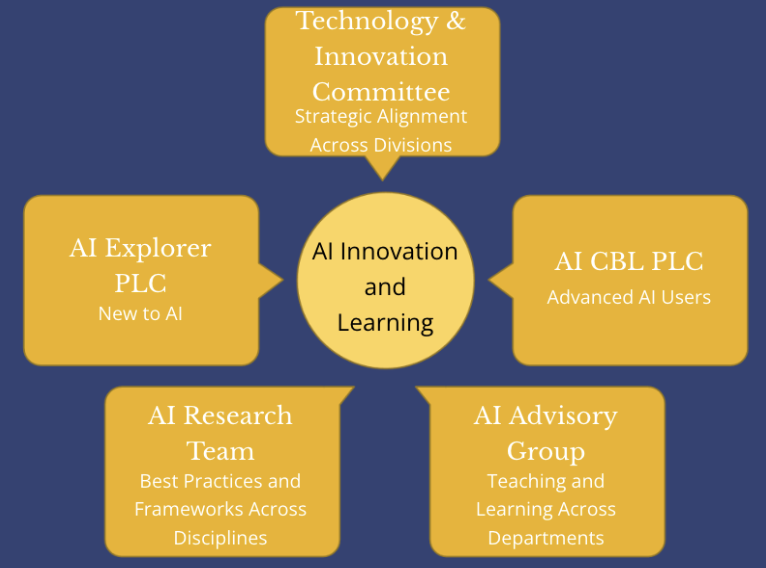
But perhaps most significantly, they built organizational structures designed to reach throughout the school (pictured above). RCDS now has five distinct groups of learners focused on AI innovation and learning: two professional learning communities (PLCs) meeting six times per year, an AI research team spanning all three divisions, an AI advisory group of non-technical teachers, and a Technology and Innovation Committee.
"Is that overkill? Absolutely not," Daren explained. These groups provide five different angles on the same challenge, representing different divisions, departments, and skill levels. Rather than opening AI work to everyone at once, divisions and departments strategically selected teachers to become internal "AI specialists." Kevin Farrant, Director of the Makerspace, and Maximo Perez, Middle School Computer Science teacher, became two such specialists.
Defining Powerful Learning First
With the second endorsement, Essential Learning Experience with AI, RCDS tackled the core question: What does powerful learning actually look like at our school? The work was about articulating their vision clearly enough to guide AI adoption coherently. As Kevin put it, “Let's make sure we define those learning outcomes before we just bolt AI to the top of this lesson.”
Teachers developed new courses grounded in this definition. Maximo's "Mindful Machines" course teaches middle schoolers not just how to use AI but also the ethics behind it. Students are now envisioning building their own large language models, creating brands, and producing work their parents are excited to see. "My projects now look like this: you have this idea; how can we tailor it? How can we get your idea out using the same principles that we've learned in computer science?" Maximo explained.
When People Start Asking Different Questions
The most telling evidence is a cultural shift. Staff now approach Maximo asking what AI could do with their work. "More people want to know how this can get done," he observed. What was once unknown territory has become normalized.
School leadership backed this work with real resources: time, dedicated roles, and strategic partners signaling AI and CBL as top priorities. "The leadership of our school understands this is important," Daren explained, "and they've allowed us to build these different teams and these different communities."
Looking Ahead
RCDS continues to refine their approach, developing frameworks for ethical AI use, and creating multiple entry points for professional learning. The school is also working with consultants to customize Jane Beckwith’s AI Friction Scale, a tool that helps teachers determine the right level of AI involvement for a given assignment or learning goal. That progress hasn’t gone unnoticed. OpenAI recently invited Rye Country Day School to be the first independent school to pilot their new enterprise platform for educators this spring.
Questions for Your School
RCDS's journey suggests that adopting AI isn't about having all the answers. It's about building the right structures to ask the right questions. They already had a pedagogical foundation in CBL. RAIL provided the framework to define powerful learning explicitly and test how AI could serve it.
If your school is wrestling with similar tensions, consider:
How clearly can you articulate what powerful learning looks like at your school?
What structures might help you ensure new technologies serve that vision rather than undermine it?
When you're ready to ground your AI work in a comprehensive framework, explore Middle States' RAIL endorsements and how they might support your journey.
Rye Country Day School is an independent day school in Rye, New York, serving approximately 890 students in grades Pre-K through 12. The school completed the RAIL endorsement in AI Literacy, Safety & Ethics in 2024 and is pursuing the Essential Learning Experience with AI endorsement.
