
AI in Their Pockets, Values on the Line: A Catholic School and Its Partner Step Up
Written by: Anju Shivaram, AI Project Manager, Middle States Association | Published February 2nd 2026
Source: NIMB, 2024
A Partnership Under Pressure
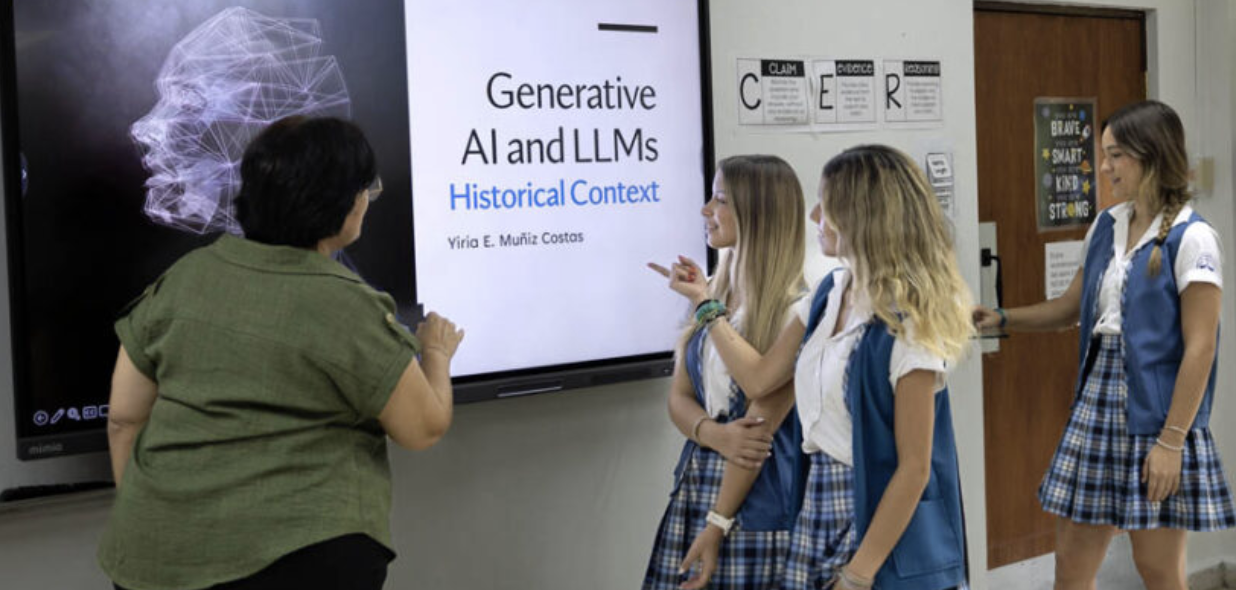
Academia María Reina (AMR), a Catholic girls' school in Puerto Rico, knew its students were already using AI on their phones long before adults had a plan for it. Teachers worried about cheating and the loss of "real" thinking. Students treated AI as a shortcut, something "there to do everything for you," as technology facilitator Anyelisa Mejías observed.
AMR decided that inaction carried greater risk. Molix Nieves, AMR's Educational Technology Coordinator and math teacher, framed it as a moral obligation: "It's our responsibility to do something."
Instead of waiting, AMR invited Forward Learning, a regional professional development and learning environment provider serving schools across Puerto Rico, to face AI head-on. They pursued two Middle States Association (MSA) Responsible AI in Learning (RAIL) endorsements as partners.
Fear, Fragmentation, and Hidden Experiments
Before RAIL, AMR's relationship with AI was uneasy. Some teachers saw AI primarily as a cheating tool. Others experimented quietly, unsure whether the school would support their use of AI. Fear shaped decisions at every level: faculty skeptical of new expectations, administrators wary of adopting powerful tools without clear ethics, teachers uncomfortable admitting they were learning alongside students. As Molix put it, educators can be "quick to judge, but very slow to change."
The central tension: Could AMR move from confusion and anxiety to a shared, ethical, student-centered approach fast enough to matter?
A Co-owned Path Through RAIL
Forward Learning does not teach students or grant diplomas, so it pursued RAIL alongside AMR. AMR contributed classrooms, students, and curriculum. Forward Learning brought edtech expertise, professional development design, and implementation support. The two organizations co-designed policies, change plans, and action research cycles.
The first endorsement, AI Literacy, Safety & Ethics, provided structure without scripting the outcome. Change plans forced the team to name a common goal and put students, not tools, at the center. Policy work surfaced hard questions about ethics and data in a Catholic school context. The cross-disciplinary team (language, math, science, and technology teachers) discovered they were not just recipients of professional development. They could design and lead it.
That realization set up the second endorsement, Essential Learning Experience with AI, focused on action research and classroom experimentation. When early contributors moved on, new leaders stepped up, showing that AI work belonged to the institution, not individuals.
From Shortcut to Collaborator
RAIL didn't eliminate tension. It channeled it into productive change. AMR worked through initial fears by grounding decisions in its Catholic mission and a clearer view of AI's risks and possibilities. Common benchmarks and a realistic understanding that "any plan is subject to changes" reduced anxiety. Teachers began to see themselves as co-designers of a new paradigm.
In Anyelisa's ninth-grade classes, students shifted from asking AI to "do everything" to using it as an ally. In one project redesigning a public space in Puerto Rico, AI supported research on community needs, but students made the design decisions. In anatomy classes, students used creative AI tools to craft stories and songs about health, deepening understanding rather than replacing thinking. Teachers reported that AI-supported work increased engagement, especially for learners with shorter attention spans.
Teachers once experimented in secret. Action research made those efforts visible. Colleagues began seeking help from the AMR and Forward Learning team. Informal peer support turned change plans from documents into daily practice.
MSA's RAIL structure provided the framework that helped AMR and Forward Learning do work they already believed in, with more clarity and coherence.
What’s Next
With both endorsements complete, AMR and Forward Learning are focused on scaling AI literacy school-wide, measuring how AI is shaping student engagement and agency, and adapting lessons to other schools Forward Learning serves across Puerto Rico and Spanish-speaking regions.
Your school's AI Story
AMR's journey suggests that AI change doesn't start with a tool. It starts with a decision to take responsibility for students' futures, even when adults are unsure and afraid. If your faculty are quietly experimenting, worried about rigor, or divided about AI's role, what would it take to move from hidden efforts to a shared, ethical, student-centered approach?
MSA's RAIL endorsements offer a structured path for that shift. The real story, as AMR and Forward Learning show, belongs to the school that chooses to act.
