
What is Wise Change in K–12 Schools? A Practical Definition with Examples
Written By: Christian Talbot, President, Middle States Association | Published January 26th 2026
You have heard us talk about wise change a lot this past year.
But what does it mean, exactly?
Let’s consider a few examples.
When Flourish Schools came to us and said, “We are creating a microschool network based on joy and experiential learning,” we said, “Tell us more.” They explained, “We need faster and nimbler accreditation to make it available at no cost to families.” Through Next Generation Accreditation, Flourish has changed from not being open to doing breakthrough work with their first cohort of students.
When Choate Rosemary Hall came to us and said, “We need to prove that we are leading the way on responsible AI,” we said, “Tell us more.” They responded, “Our faculty are in very different places, and the wider world doesn’t realize how much work we have done.” Through the RAIL endorsement in AI Literacy, Safety, and Ethics, Choate changed from being unaligned on AI to sharing understanding about the “discerning, informed and ethical use of AI.” And they have gone from no public recognition to credentialed leadership in ethical AI use.
When The Journey School, The Academy of St. Paul, and Gill St. Bernard’s came to us (at different times) and said they needed a professional development solution for all day in-services, we said, “Tell us more.” They explained that their teachers were all in different places when it came to AI. Through whole-school access to Evolution Academy AI 101 and AI 201, well over hundred teachers have gone from “I’m not sure where to start with AI” to individualized playbooks for implementing AI.
Maybe these examples resonate with your school’s change agenda. Maybe they sound very different. One way or the other…
Rest assured that when we talk about wise change, we are thinking about you.
Classroom teachers create wise change for their students.
Administrators create wise change for faculty and staff.
Staff create wise change for… well, almost everyone!
Whatever your official title, you are a change leader—whether you want to be or not.
And our purpose is to help you ensure that the change you lead is wise.
Laura Light, Executive Director of AAIE, said that change leaders approach their work as a craft. That comment inspired us to highlight a few techniques for leading wise change below.
Are you facing a challenge or opportunity related to wise change at your school? Join office hours with me. You share your situation, and I will work with you to identify concrete next steps.
Secure your spot:
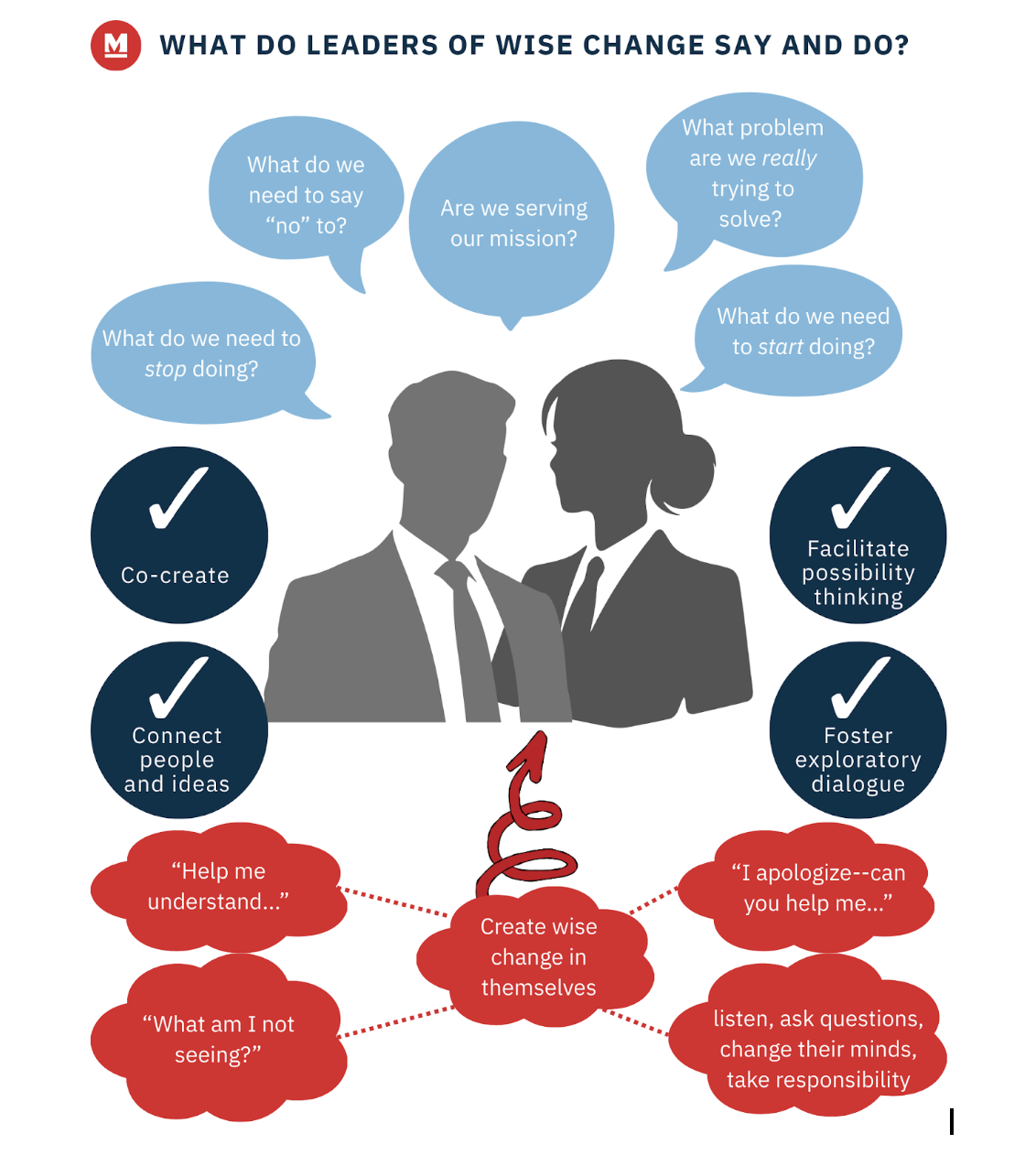
Source: Middle States Association
