
What Is Purpose Without Identity?
How Pinewood American International School Stopped Asking What AI Could Do
Written by: Anju Shivaram, AI Project Manager, Middle States Association | Published September 11, 2026
A Committee Full of Energy, and a Faculty That Stayed Put
Pinewood finished its first RAIL endorsement with a policy framework, a Gen AI framework for the high school, and a committee that believed in the work.
What it did not have was the faculty.
"The committee was full of energy," said Roxanne Giampapa, Head of School. "Getting the wider audience on was a little more difficult."
No visible cohort of early adopters emerged to show the rest of the faculty it worked.
Attention Was Only Part of the Problem
During the first endorsement, Pinewood was preparing for its Middle States Sustaining Excellence Colloquium, a school-wide improvement process built on action research. All sixty-four teachers were already conducting classroom research for it.
Competing priorities with the colloquium were part of it. But the committee also came to see that it had been treating AI as a technology question rather than a question of purpose. Roxanne explained, “We had been choosing which tools to procure and deciding who would use them in which division. We lost sight of the purpose."
Pinewood was also unsatisfied with the IB Learner Profile they had been leaning on for years. While the school fully embraced its attributes, the language read as a list, and a list could not describe who a student was becoming. "We really wanted was to move from thinking about what students can do to how students choose to act," Roxanne said. "Agency." What kind of human being should emerge from a Pinewood education, given today’s global context?
Answering Identity First
To renew their Portrait of a Graduate, Pinewood surveyed teachers and students and landed on these four shifts:
FROM AI as a tech question — TO AI as a purpose question
FROM what students can do — TO how students choose to act
FROM lists of qualities — TO coherent human development
FROM performance in school — TO preparation for life
From these four shifts, they drew on Greek roots and the international character of their community, and arrived at five integrated dimensions for their Portrait of a Graduate (below).
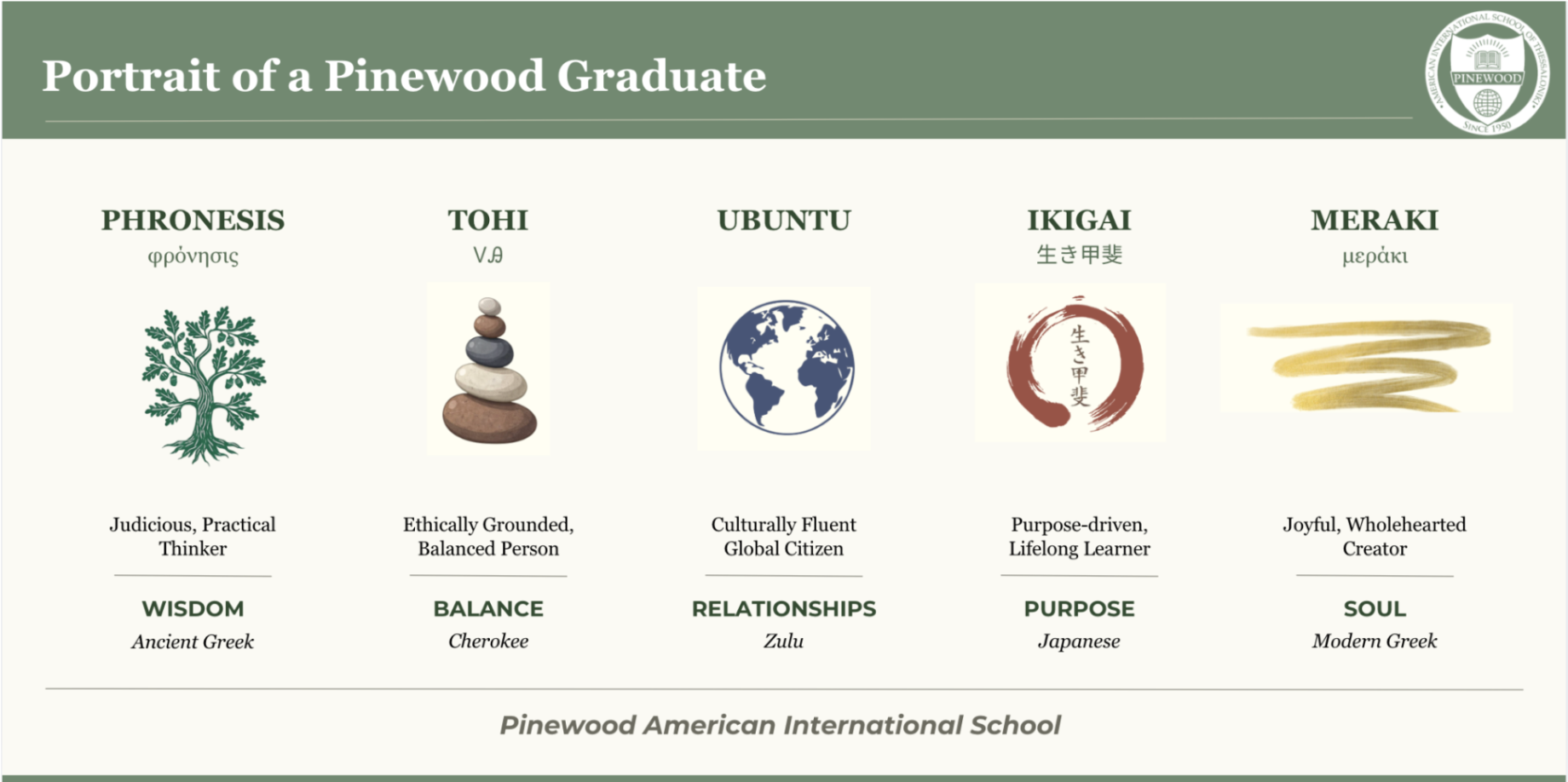
"Students are formed in school, but they're not finished," Roxanne said. They are in the process of “becoming,” which speaks to how student agency forms character. The Portrait shapes Pinewood's Declaration of Powerful Learning (DPL), which describes what success looks like for the most important kinds of learning experiences at their school. This is one of the foundational assets schools create in the second RAIL endorsement, Essential Learning Experience with AI.
Pinewood's mission, Portrait and Declaration work as a constellation, anchoring the school's culture and identity and serving as a north star for what comes next.
Why Faculty Came Along This Time
The colloquium work became the foundation for what followed.
"Teachers understood what action research was," Roxanne said. "They had had experience with it over these last three years. When we presented that you'll be doing these action research sprints as part of the second RAIL endorsement, there was a familiarity. A lot of people had also been playing in the sandbox of AI already…the conditions were right."
The endorsement asks for 25% of faculty. Pinewood got more than 40%.
What the Sprints Taught Each Division
In the high school, two history teachers fed documents from the Russian Revolution into an AI platform, built a Lenin persona, and invited students to dinner with him. Apostolos Rofaelas, High School Principal, calls the result the politeness paradox. "How many times when we actually use AI, how do we behave? Aren't we blunt? Do this, give me this analysis. Fix this. Where is the human aspect there?" In this exercise the students were the guests, with an authoritarian figure seated across from them. "So they have to remind themselves of what it means to be human when dealing with AI."
The middle school took process over product as its lesson. "In a sprint, you may not always find a solution or the solution," David Mannell, Middle School Principal, said. "Sometimes you finish a process and think I don't totally know what I learned, but it did help me to think about how to approach problem solving."
The clearest result came from a student. In one sprint, a seventh grader wrote that "now that we're still in early grades when we learn how to learn or study, and if we use AI, not only are we never learning, but also we will start depending on AI way too much."
David reads it as the identity question arriving on its own. "What a powerful thing for a seventh grader to think of…it is a great example of phronesis in action."
In the elementary school, no children use AI at all. "Our children are obviously too young to use AI," said Karen Georgacacos, Elementary Principal. Her teachers were the ones learning, and she expected fewer early adopters given how hands-on elementary planning is.
By the end of two sprints, every age group had found a use. "Everybody found a way to use AI to increase reading comprehension, to help with the PYP exhibition," Karen said. "Every age group realized that AI works across the board for every subject for every age group." Teachers who had never opened an AI tool now use them regularly.
The structure mattered more than the tools. "We found that the two cycle structure turned what you would call mistakes or difficulties into data for the teachers that they could then look at and reframe how they want to teach," Karen said, "which is a breakthrough for us as we're becoming more of a data informed school."
Demet Gökalp, IT Teacher and EdTech Specialist, works alongside those teachers. "Sometimes they don't want to use the new tech tool, but I always try to support them," she said. "We need a purpose, not only using a tool."
The kindergarten sprints show what that means. The first sprint produced AI-generated storybooks personalized for each child, and the children loved them. For the second sprint, the team returned to the Declaration and added choices, letting students decide what happened next. "Some quieter students can choose something," Demet said.
What Comes Next
Assessment remains an open question, and Roxanne says “we are still struggling with how we’re going to KPI these things.”
The middle school has renamed its advisory program Character, Ethics, Joy, and the official Portrait of a Graduate rolls out to faculty this year.
"We came into RAIL to get better at AI," Roxanne said, "and we left with so much more."
Your school has a list of graduate attributes. Most schools do.
Could your teachers tell you what those attributes look like in a Tuesday lesson? Could your seventh graders?
Pinewood American International School serves 600 students from PreK through Grade 12 in Pylea, Greece as a PYP, MYP and Advanced Placement school. The school completed the first RAIL endorsement, AI Literacy, Safety & Ethics, in 2024 and the second, Essential Learning Experience with AI, in June 2026.
Want to learn more about RAIL? Visit msaevolutionlab.com/rail
