
Written by: Anju Shivaram, AI Project Manager, Middle States Association | Published January 5th 2025
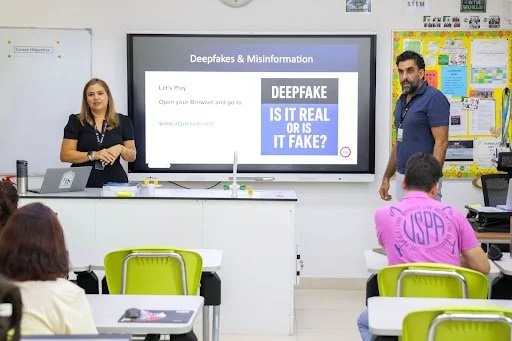
Image Source: Bahrain Bayan School
When generative AI surged into schools, Bahrain Bayan School initially responded the way many did: with guidelines and one‑off trainings aimed at keeping pace with a fast‑moving technology.
Joining Middle States’ Responsible AI in Learning (RAIL) endorsement shifted that response from reactive to structured, helping the school design AI use that is human‑led, ethically grounded, and sustainable.
RAIL as a focusing framework
“I feel RAIL gave us the structure of where we should focus and get other members of our community that might have been overlooked before,” says Director of Digital Strategies and Innovation, Tamara Fakhoury.
The endorsement clarified priorities, highlighted gaps, and offered assurance “we are heading in the right direction and there are proper guidelines and structure of what to do next.”
Curriculum moves: AI ethics and knowledge across K–12
One major outcome is an AI Ethics and Knowledge unit that runs from Kindergarten through Grade 12. Rather than treat AI as a standalone topic, Bayan weaves questions about power, bias, and responsibility into technology education so that students learn not just what AI can do, but what it means for them and their communities.
In the upper grades and in the IB program, a schoolwide AI Ethics Code anchors advisory and Life Skills classes. Teachers give students explicit guidance on academic integrity, AI‑assisted writing, and proper citation practices. The school aims to equip students to make informed decisions in a world where AI is a routine part of learning and work.
Safeguards and practical tools
RAIL also prompted Bayan to tighten data privacy practices and make safeguards tangible.
“We even created a student number randomizer for them that they can use when they're uploading data into an AI agent,” Tamara notes, “so they're not sharing any of the student's personal information.”
In classrooms, teachers use AI in targeted ways, for example, supporting teachers with report card comments, within the boundaries of the ethics code, and balanced with active, discussion‑rich lessons. Activities such as “student feud” games help students surface their assumptions and questions about AI in a low‑stakes, engaging way.
Responding to real harm
A turning point came when a student’s IB essay was incorrectly flagged as plagiarized due to language model bias.
“She came into my office in tears… wondering why her essay was marked plagiarized,” Tamara recalls.
Instead of treating the incident as a one‑off error, the school responded with targeted training and clearer guidance for IB students on safe, transparent AI use. The episode catalyzed refinements in policy and support rather than retreat from AI altogether.
Shared ownership for AI work
To make AI work durable, Tamara built a cross‑divisional RAIL team that includes champions from primary, middle, high school, and administrative staff. These champions introduce themselves to colleagues as local points of support for questions about AI use, ethics, and tools, so AI decisions are not confined to a single office or committee.
Professional learning structures, full‑day sessions, weekly PD, and concise “tech bites”, now operate within a clearer RAIL‑informed frame, helping staff move from awareness to confident, ethical practice with AI.
What’s replicable
Bahrain Bayan School’s RAIL journey illustrates what it can look like when an endorsement becomes a living framework rather than a line in a profile. RAIL helped the school:
Move from reactive guidelines to a coherent AI Ethics and Knowledge curriculum.
Turn ethics into concrete safeguards, codes, and classroom tools.
Use real incidents, like the IB plagiarism flag, to strengthen training and policy.
Build shared ownership for AI work through champions and structured PD.
Tamara notes that school leadership is “very happy with the progress so far” and has called a dedicated board meeting to review Bayan’s AI roadmap and next steps for schoolwide implementation, a reminder that this work is ongoing strategy, not a one‑time initiative.
For schools looking to move from AI experiments to coherent, ethics‑driven practice, RAIL offers a framework and community for thinking through similar questions at multiple layers, culture and identity, governance, safeguards, and classroom practice, so that change is built from the foundation up.
