Permission to Be Who We Are: How The Mission Academy Unlocked Choose Act Funding Without Changing Its Model
Written by: Jake Galloway, VP Member Success, Middle States Association | Published April 1st 2026
"There's Got to Be Something More"
Tiffany Jones spent four years teaching special education in public school, watching the kids who needed flexibility the most get buried under paperwork and testing protocols instead. She knew education could work differently. She just didn't have a name for how.
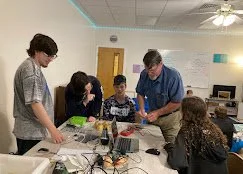
Then she discovered microschooling. It was everything she'd been looking for: a model built around meeting each kid where they are, not forcing them into a system that wasn't designed for them. She adapted the concept for her community in rural South Alabama -- Christian, learner-driven, mastery-based -- and opened with five kids.
Within months, the evidence was hard to ignore. A child who arrived at nearly 12 unable to read began reading. A student who used to hide under desks started answering questions. More families showed up, drawn to the flexibility they couldn't find anywhere else. The model was working. And word spread.
But every time a new parent walked through the door, the first question was the same: "Are you accredited?" And every time, Tiffany had to piece together a patchwork answer -- “The curriculum we use has accreditation behind it…Here's how we meet standards…Let me walk you through each piece.” It was true. But it didn't land the way the work deserved. Parents would nod, but she could feel the hesitation. The trust her model deserved in practice wasn't showing up in that first conversation.
"How in the World Do I Explain This to Them and Have Them Hear Me?"
When Alabama's Choose Act opened up to $7,000 per student in funding, accreditation went from back-burner to urgent. Tiffany started looking for providers. What she found made her stomach tighten.
The accreditation agencies she explored were built for conventional schools. High per-student fees that would eat into already thin revenue. Requirements for credentialed teachers her community couldn't supply. Standardized curricula that contradicted the flexibility her families chose the school for. She watched a pastor at a nearby accredited church school wearing thin under requirements that didn't fit his context -- minimum degree counts, rigid staffing ratios, structures that pushed his school toward something it wasn't meant to be.
But the deepest barrier wasn't cost or compliance. It was translation. Learner-driven. Mastery-based. Flexible curriculum. Faith-integrated. Each term needed its own defense, and Tiffany couldn't figure out how to get any of these accreditors to hear what she was actually doing. "It was just very daunting to even figure out how to approach them, how to even word what we are." So she kept putting it off.
"I Didn't Even Have a Question"
Then MSA's NGA Micro pathway showed up in her social media feed through the Rebel Educator, a voice she trusted in the microschool community. Tiffany read the description and didn't hesitate. "I was like, this is it." What made it click was the absence of the thing she'd been dreading. She didn't have to translate microschooling into traditional-school language. She didn't have to justify her Christian identity. She didn't have to defend her flexible curriculum.
Her first conversation with MSA left her with something she hadn't expected: encouragement. Not because it was easy, but because no one asked her to be something she wasn't. "I never felt like I had to hide who I was. I was able to just be myself."
The self-study pushed her to get things out of her head and onto paper. Policies she'd been meaning to formalize got formalized. Background checks that were half-done got completed. The Declaration of Powerful Learning -- a document unique to MSA -- became an unexpected communication tool. Where she used to walk each parent through every piece of her model individually, she now has one page that summarizes who The Mission Academy is.
Funded, Filed, and Finally Clear
The Mission Academy now qualifies as a K-12 private school under Alabama's Choose Act, unlocking up to $7,000 per student in annual funding. The documentation Tiffany produced during the self-study became the foundation for her nonprofit filing, which she completed in a single day. After three years of volunteering her time, Tiffany may finally draw a salary next year.
The ripple effects go beyond funding. Her families' biggest fear was that accreditation would force the school to change its methods. Tiffany was able to tell them truthfully: nothing is changing. That answer kept families in. And the accreditation question that used to require a five-minute defense now has a three-word answer: "Yes, we are."
She's also started giving back to the community that supported her. Tiffany served on a visiting team for another NGA Micro school in St. Augustine, shifting from someone going through the process to someone helping others navigate it. "It's not like y'all vs us. This is a journey together. It has truly been a partnership."
A New Location. A Sharper Story
This spring, The Mission Academy is moving to a new church with lower overhead and room to grow. The school board has voted to pursue an independent facility long-term, backed by partnerships across multiple churches.
Three years ago, she opened with five kids and a conviction. Now she has a school with a plan.
Your Model. Your Terms.
What would change at your school if accreditation didn't ask you to become something different, but helped you become more of what you already are?
The Mission Academy, located in Atmore, Alabama, is a learner-driven K-12 Christian church-based microschool led by founder Tiffany Jones.
