
Meet Joshua Dorsey
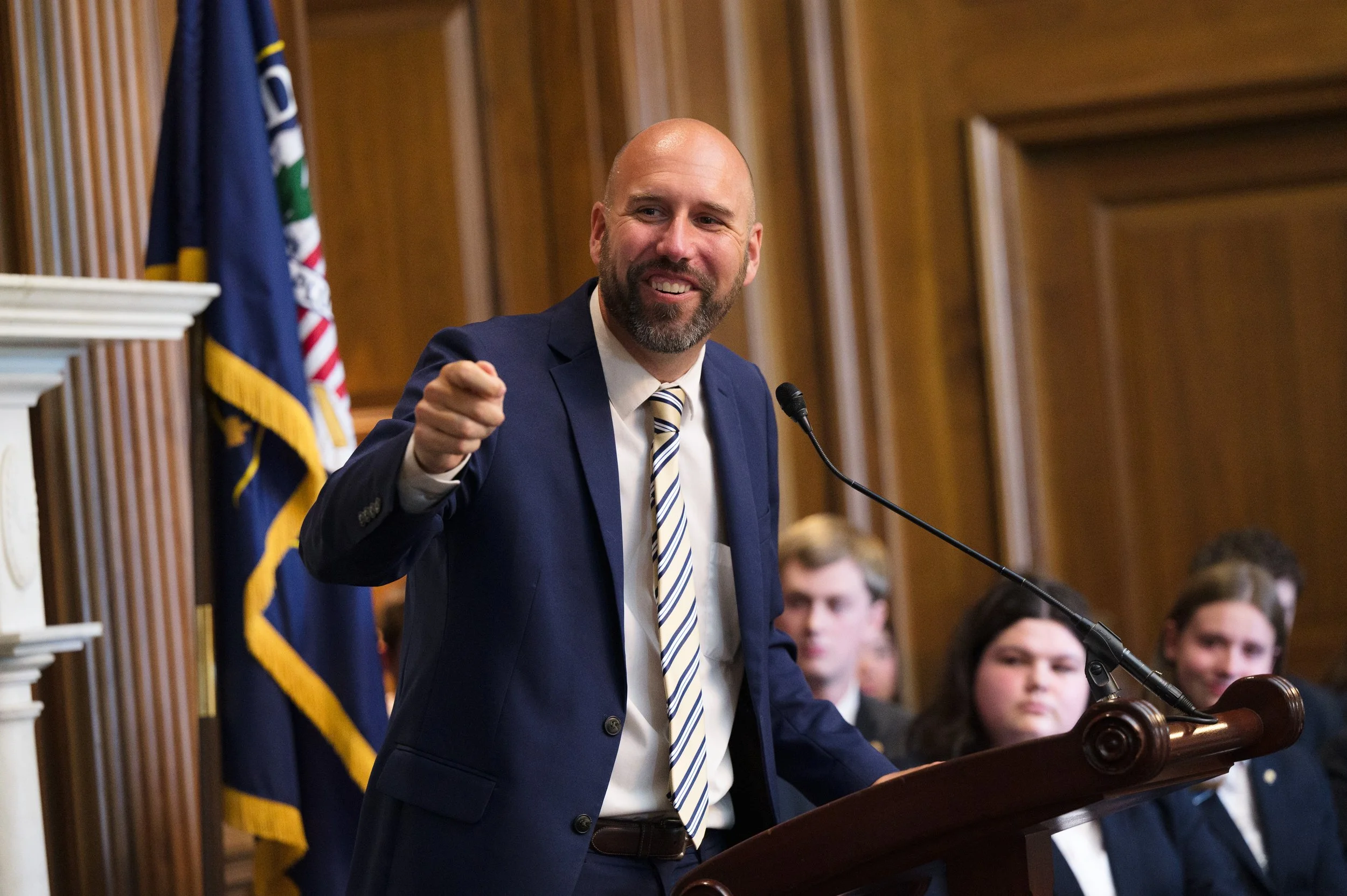
Joshua Dorsey, Principal
MSA: Tell us a little about yourself. How did you land in the world of education and what has your journey entailed?
Josh: I taught high school Calculus and coached Cross Country and Track at public schools in Maryland for five years before I was unexpectedly asked to apply for a position at the U.S. House of Representatives Page School in Washington, DC. Despite living only twenty minutes from the Nation’s Capital, I had never heard of a Page or visited the Library of Congress (where the school was located). I accepted an offer to become their Mathematics Instructor, and have worked with Pages in some capacity for almost the entirety of the last twenty years.
The House Page Program was discontinued in 2011; however, within a few years of its closure a former colleague notified me that the Senate Page School was hiring. Four years after becoming their Mathematics Instructor, two years after a discussion with my supervisor regarding my interest in being part of the school’s succession plan, and one year after earning a Graduate Certificate in School Administration and Supervision from Johns Hopkins University, I was named the school’s Principal.
Although I miss the classroom, with each passing year I’ve come to enjoy being in a leadership position more. I have been blessed with a fantastic team of dedicated educators, who serve an ambitious, bright, and thoughtful student body. Each day when I leave work and see the Capitol dome, I find it a little difficult to believe where I work and what I do.
MSA: Thanks for sharing that with us. What motivates you to work in the field of education?
Joshua: The U.S. Senate Page School enrolls students from across the country, each sponsored by a U.S. Senator, for a semester of their junior year. Although many of our students enter and exit their appointments brimming with confidence, imposter syndrome is incredibly common, particularly after learning that sitting Senators, Governors, and Supreme Court Justices all used to be Senate Pages.
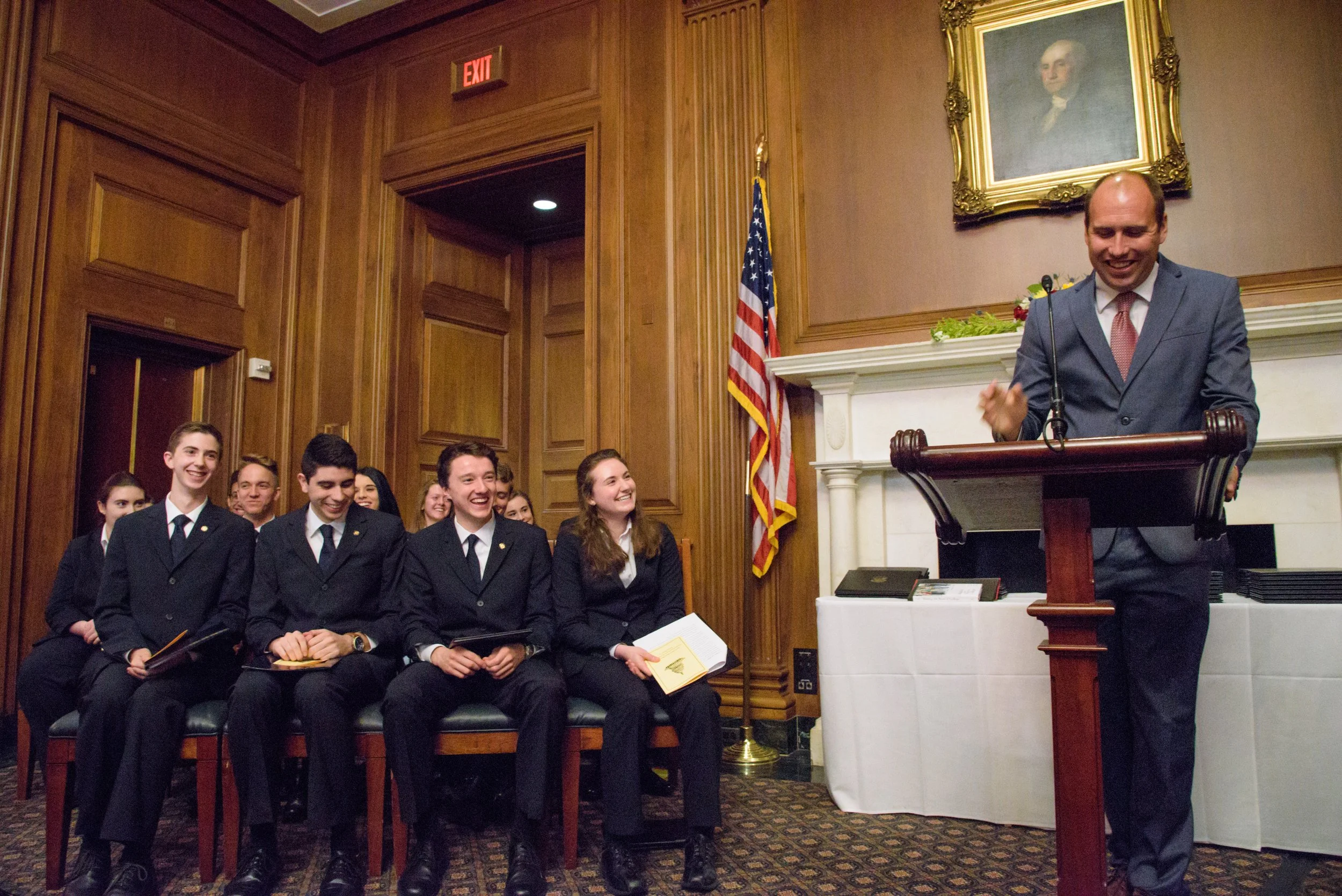
Consequently, one of my favorite parts of being the Principal at the Senate Page School is convincing nervous teenagers that they absolutely belong in our Program and then guiding them through five months that are equal parts challenging and transformative. I’ve seen first generation college students, whose parents speak minimal English, receive full-rides to MIT. I’ve worked with Pages who couldn’t make direct eye contact with their instructors eventually deliver incredible speeches at our Closing Ceremonies, with guests including families, members of Congress, and Officers of the Senate. I often hear students reflect on their brief time on Capitol Hill as a time that redefined what “doing something hard” meant to them, which in turn has pushed them to pursue greater challenges in college and as an adult.
Each semester there are Pages who need someone to tell them “you can reach higher,” while still affirming that the effort they are putting forth is seen. Others, as a recent Page wrote to me, need assistance in “navigating an environment I often feel out-of-place in.” That I can have a profound impact on their academic life simply by communicating that I believe in them and by encouraging them to control their attitude, preparation and effort, is one of the most gratifying and motivating aspects of my work.
MSA: Describe a specific change project you have been a part of. What were the main obstacles? How did you overcome them?
Joshua: Last year we launched a Morning Meeting program, where the student body gathers as a whole in the hopes of establishing awareness about the diversity of the class and providing an avenue for Pages to share about their lives at home. Frequently these presentations focus on personal interests (robotics, debate, horseback riding) or regional quirks (the Idaho Potato Drop on New Year’s Eve in Boise). Other times, however, we learn about what it's like to go to Hebrew School, the significance of Carnatic Music in one’s family, or what Christmas is like for a student whose parents immigrated from Ukraine.
In this way the Morning Meeting program has been an accessible entry point for our students to discuss how one’s culture and community shape their identity as well as their values. It also brings into focus that the individuals they’ve laughed, cried, and grown to love and respect over a five-month period vary greatly in terms of their political beliefs, the faiths they practice, their socio-economic background, and the personal challenges they’ve had to overcome in life. When Pages return to their home schools, they often do so knowing someone from the deep south, someone who celebrates Diwali, someone who has a family member here on a work visa, or even someone who takes a boat to school.
Identifying the best medium to have conversations such as these that are student-led, nonpartisan, and productive is a work in progress. We’ve had students comment that our programming places too much significance on one’s background and culture, as well as those who’ve expressed that we’re not emphasizing these attributes enough. I anticipate we’ll continue to make small modifications with the format for presentations and the parameters we provide students based on what we’ve learned so far. I also suspect that each semester’s group will vary significantly in terms of their eagerness to share and their willingness to hear.
MSA: What author / book / podcast has played an important role in your development? What are 1-2 valuable nuggets of wisdom you have gleaned?
Joshua: I’ve always been interested in learning more about the impact our subconscious has on the choices we make, the values we champion, and the things that motivate us. Both Thinking, Fast and Slow by Daniel Kahneman and The Righteous Mind by Jonathan Haidt have been immensely helpful in my ability to better understand my students and myself.
More recently, however, I read The Running Ground by Nicholas Thompson. The book is ostensibly about running but includes a number of insights that are easily adapted to academics, covering everything from the psychological effect of drinking beet juice to the importance of acquiring and sustaining momentum.
A takeaway worth mentioning is the realization Thompson has towards the end of the book. After being a strong (but not standout) runner throughout high school, college, and early adulthood, in his forties Thompson became both an American record holder for the 50K and, for his age-group, ran the fastest 50-mile time in the world. A few months after the race he concludes he hadn’t been able to run that fast in years prior “because I hadn’t wanted to.” He had been satisfied with staying roughly the same year-over-year and had developed training plans and race goals with a somewhat complacent mindset. That he was able to transition from pretty good to elite simply by choosing to set his targets substantially higher leads me to believe the same may be true for many of us in our personal and professional lives: when we vastly underestimate what our full potential is, and we craft goals based on that underestimation, we may remain unaware of what’s actually achievable. Or, as he puts it: “we all contain different versions of ourselves buried deep inside. The faster Nick had always been there, perhaps for 25 years.”
MSA: What is one thing about the current state of education that worries you or excites you?
Joshua: I worry, almost obsessively, about how much time students spend looking at screens every day. Even if we ignore the content these screens are delivering, the ratio of time students spend interacting in one-to-one or one-to-few synchronous, human-to-human relationships versus that spent in one-to-many asynchronous, human-to-technology interactions troubles me. At home, my middle child’s largest struggle in middle school hasn’t been algebra or social studies, but restraint; when I checked his school-issued Chromebook early last year, in between searches for AC/DC lyrics and NBA box scores, during class he was also googling variations of “how do I focus” or “how I stay on task” multiple times per week.
Determining how and when technology is used in the classroom is currently challenging, and I suspect it will only become more difficult in the years ahead. I feel fortunate to be leading a small team that recognizes society is increasingly dependent on technology but also believes that often the clearest path to having students think independently or develop abstract reasoning skills is by collaborating on a problem at the board, annotating a document, or having a roundtable discussion.
MSA: Thank you for sharing your change story with us Joshua.
Contact: joshua_dorsey@sec.senate.gov
