
The Power of PR in Leading Change
Written By: Christian Talbot, President, Middle States Association | Published December 8th 2025
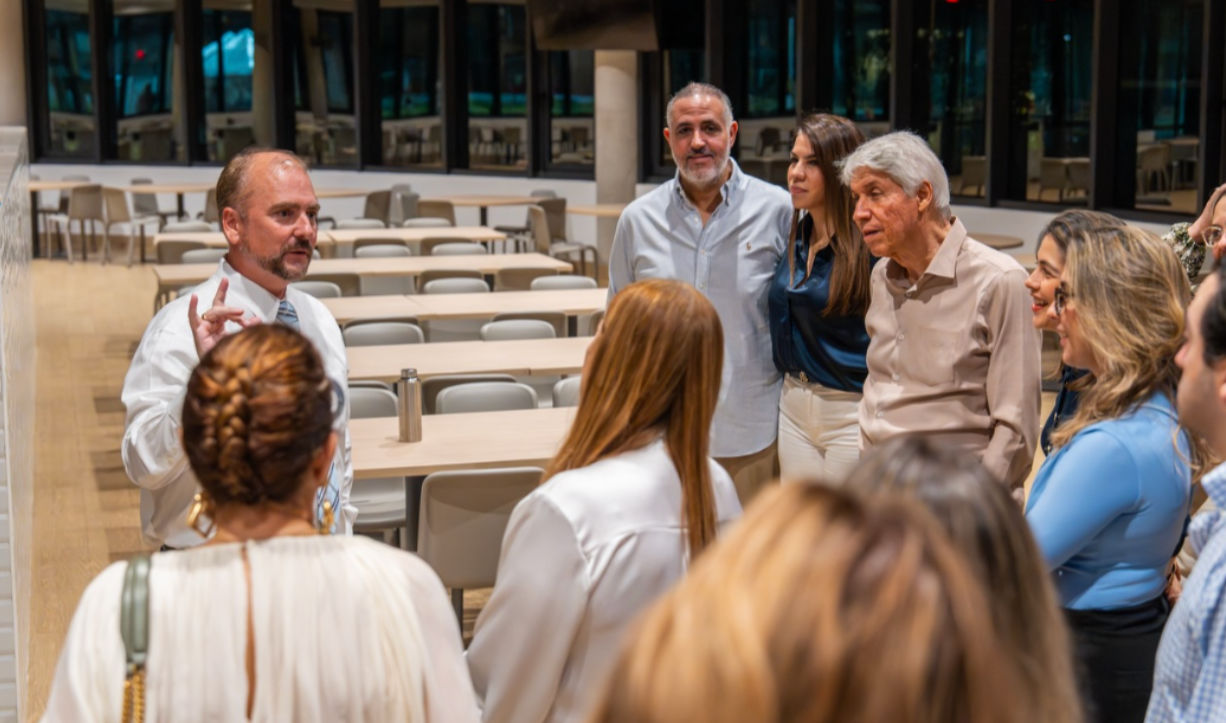
Brian Kelly, Head of School, speaking to Carol Morgan School alumni. Photo Credit: Carol Morgan School
You are a school leader.
Everything around you is changing.
You know in your bones that what got your school here will not get it there. So you initiate an important change project.
But then alumni who love their school—now also your school—beg you, “Please don’t change it!”
What do you do?
Dr. Brian Kelly, Head of School at the Carol Morgan School (Dominican Republic), faced this situation when launching the school’s new Arts, Innovation and Dining Center.
When I interviewed Brian recently, he shared that his solution sprang from his early training in public relations.
“Public relations is fundamentally about storytelling,” he said. Here are three of his strategies for using storytelling to catalyze positive change in schools.
Lesson 1: Tell a clear story about why change matters
Sometimes when stakeholders confront Brian about change, he surprises them with a familiar story in an unfamiliar context.
“Do you remember your first BlackBerry?” he will ask.
Many smile.
Then he reminds them, “Where is the company that made the BlackBerry now? If you’re not changing, you can quickly become irrelevant.”
His audiences immediately get the point—their beloved schools cannot survive on nostalgia. He doesn’t need to tell the entire narrative of BlackBerry’s demise. The analogy cuts through the emotions and rationalizations instantly.
Lesson 2: Design your change project as a story engine
Brian also has learned that innovation requires sustained storytelling.
So when it came time to design Carol Morgan’s new Arts, Innovation and Dining Center, Brian wanted the building to become a story generator.
With flexible spaces designed for inquiry, collaboration and performance, the building signals that the school’s story is evolving: Carol Morgan is not abandoning its past, but it is preparing students for a different future.
Not only will students engage in new, innovative learning, which will produce new stories of learning; the building includes space for public demonstrations of that learning.
In other words, the Arts, Innovation and Dining Center will function as a story showcase. Every time students engage in powerful learning, the school will be able to share another story—another proof point—about why the change matters.
Of course, the building can only contain the stories. People have to bring it to life. And that is why Brian relies on the story of “collective efficacy” to create positive change.
Lesson 3: Teach people to tell the story of “collective efficacy”
Many schools want their change story to be linear: Create a strategic plan. Fund it. Execute.
For Brian, leaders can’t merely point to a vision and expect people to change, no matter how compelling the vision. Instead, leaders have to shape the story that faculty and staff tell about themselves.
At Carol Morgan, he said, “We needed to make sure not only that everybody understood the vision, but also that people felt collective efficacy. If you don’t have a group of people that believe that their work together will assure that kids succeed, then you have a problem.”
How does Brian approach the work of developing collective efficacy? He lifts up teachers by naming and celebrating their work, knowing that recognition feeds efficacy.
“You have to get to a place where the faculty feel prepared,” he said. “Then you’ve reached a critical-mass point at which you can say, ‘Now we’re moving to collective efficacy,’ as opposed to individual teachers being the only ones carrying that load.”
Every school eventually faces a “Please don’t change it” moment. Will you shrink your school’s story to preserve what once was? Or will you expand the story to honor the past and meet the future?
