
The Conversation Before the Policy: How CAISL Built AI Trust with Parents
Written by: Anju Shivaram, AI Project Manager, Middle States Association | Published April 29th 2026
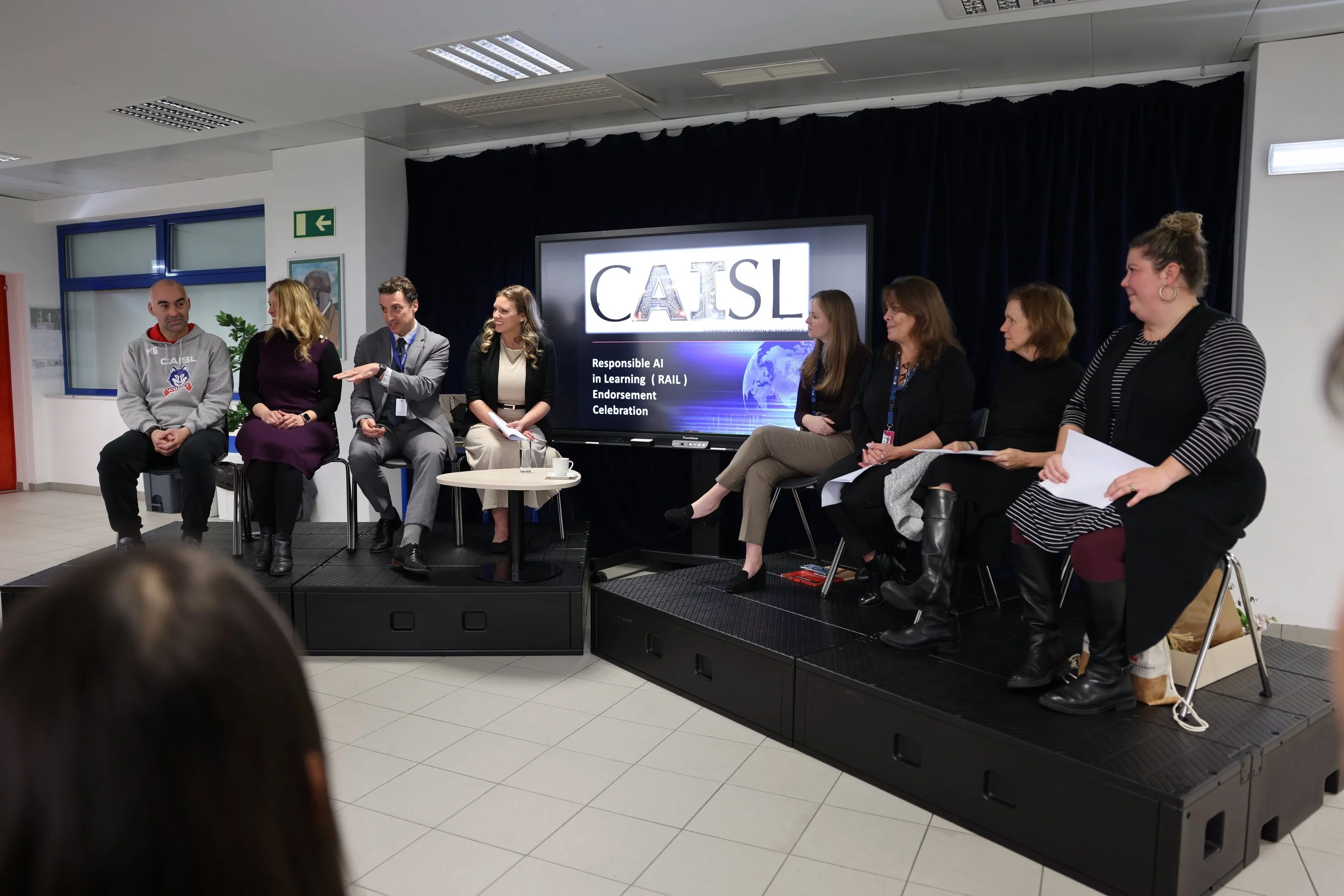
The CAISL RAIL team (from left to right: Marco Garcias, Leslie Selberg, Nate Chapman, Tiffany Mack, Morgan Mifflin, Vera Tamen, Eileen Kless, Lauren Boop) at the RAIL endorsement celebration. Photo courtesy of CAISL.
"You see how quickly this landscape is evolving, and there was really nowhere to go for formal guidance. Nowhere to find a place to stand."
— Nate Chapman, Director, CAISL
A School That Moved Toward the Fire
The Carlucci American International School of Lisbon (CAISL) sits in Sintra, Portugal, on the edge of where the city gives way to something quieter. It is an international, nonprofit school in a competitive market.
When generative AI arrived, Nate Chapman, who has been at CAISL for two decades and director for four years, made a deliberate choice. He moved toward the problem, enrolling in the RAIL endorsement in AI Literacy, Safety, and Ethics, and, harder still, starting the conversations.
The Gap That No Policy Can Fill
Before CAISL had a framework, it had anecdotes. A student referred for academic malpractice. Headlines from other schools. The low hum of things everyone knew were happening but no one had named out loud. Nate describes it plainly: "Until you start shining a light on this and having the intent to say we're going in this direction, a lot of those conversations sit in the shadows."
What made the shadows harder to navigate was the nature of this particular disruption. AI didn't hold still. What a parent believed about it six months ago might have shifted completely by now. A school could write a policy and believe it had handled the problem. It hadn't. It had just issued a document.
Kim House joined CAISL this year as Curriculum and Innovation Coordinator. The RAIL groundwork was already in place when she arrived, but the harder work, translating policy into daily practice, was not. When she started talking to teachers, parents, and students, she found the same thing Nate had been watching for years. "This is not about tools," she said. "This is about broader change on a level that I thought COVID was going to force. It did not. AI is doing it."
Going Public
Rather than announce the endorsement quietly in a newsletter, the school held a formal celebration for faculty, parents, and students. A panel, including the RAIL team and Middle States representative Morgan Mifflin, walked the audience of students and parents through what the school had accomplished during the 16-week endorsement and how new policies would take shape going forward. They invited pushback and were candid about what they still did not know. Optimism filled the room, as students expressed a desire to take part in rolling out the new policies and were eager to share their own perspectives on how AI might shape their educational futures.
“I was incredibly impressed at how open the CAISL leadership team was with their community. AI can feel like a scary subject to tackle, especially with parents, but inviting those groups into the conversation, rather than boxing them out, does wonders for trust building.”
– Morgan Mifflin
Into the Room With Parents
That presentation opened the door. Keeping it open required something more sustained.
AI is, as Nate puts it, low-hanging fruit for parent engagement. Every parent has a stake in it. It is new to them too, and they are paying close attention.
Kim took on much of that work directly, running sessions with parents that surfaced something the team inside the building had started to take for granted: the gap between what educators now understood about AI and what parents were working with was wider than anyone had fully reckoned with. Two ideas landed hardest. The first was cognitive offloading, the risk that students stop developing their own thinking by outsourcing it to a tool. The second was what AI literacy actually means, which is not the same thing as knowing how to use AI. Parents needed both concepts named and explained before any conversation about the school's approach could go anywhere useful.
What CAISL discovered through those sessions was something more useful than reassurance. Parents started revealing how they themselves were using AI at work. A parent in HR. A parent in the arts. A parent in recruiting. The school is now designing a career day format: parents coming in to show students what AI actually looks like across different professions.
"What a school chooses to celebrate shows where its values are," Nate said. Celebrating the endorsement with parents sent a signal about what kind of school CAISL is trying to be.
What This Means for Your School
What structures does your school have for reaching parents on AI, beyond announcements and newsletters? When you walk into a room full of parents who are worried about something they do not fully understand, what do you bring with you?
CAISL brought a framework. They had something credible to stand on before the conversation started. This framework can do the same for yours.
Learn more about how Middle States supports schools doing this work.
CAISL is an American international, nonprofit school in Sintra, Portugal, serving approximately 757 students from early childhood through grade 12. The school completed the RAIL endorsement in AI Literacy, Safety and Ethics in 2024.
